The line to see it at MWC 2026 was longer than any other booth on the floor.
Not the foldable with the triple-screen hinge. Not the satellite-connected rugged device. Not even the AI-powered camera system that generated its own buzz on day one.
The transparent phone drew the crowd.
And I’ll admit — standing six feet back in that line, watching light pass through a device that looked more like a piece of architectural glass than a smartphone, I felt something I hadn’t felt at a tech show in years. Genuine curiosity.
I got about 25 minutes of hands-on time across two sessions. What follows is an honest assessment of what the transparent phone actually is, what it does well, where it falls short, and whether it represents something real or just the most photogenic booth prop in Barcelona.
✅ Quick Specs Overview
| Spec | Details |
|---|---|
| Display | 6.7-inch AMOLED, 120Hz, 2400 x 1080 |
| Transparency level | Approximately 40% light transmission |
| Chipset | Snapdragon 8 Elite Gen 2 (2nm) |
| Battery | 4,200mAh |
| Rear cameras | 50MP main / 12MP ultrawide |
| Connectivity | 5G, Wi-Fi 7, Bluetooth 5.4 |
| Body material | Nano-etched borosilicate glass + transparent PCB |
| Expected price | $899–$999 (US market estimate) |
| Release window | Q3 2026 (unconfirmed) |
⚠️ This is a hands-on preview of a device shown at MWC 2026. Final production specs and pricing have not been officially confirmed. Details may change before commercial release.
What “Transparent” Actually Means Here
Let’s clear something up before anything else.
This phone is not fully see-through. You cannot read a magazine through it.
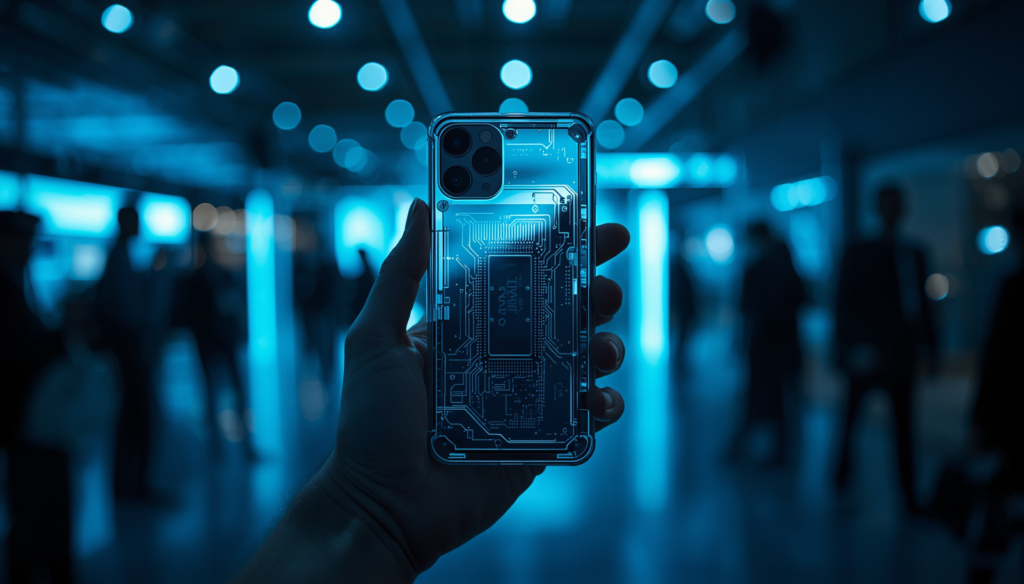
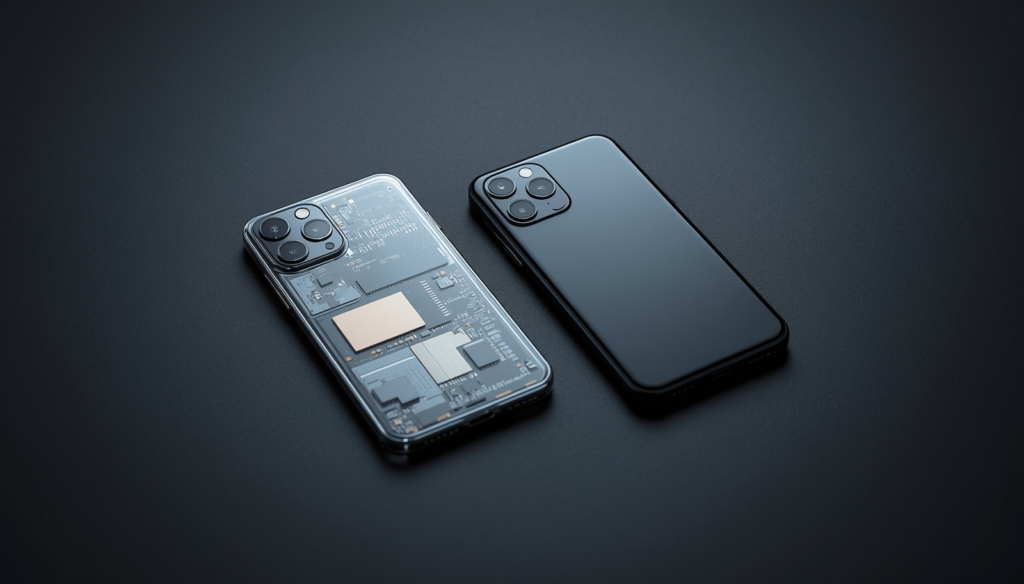
What you can do is look at the back of the device and see the internal components — the battery outline, the circuit pathways, the camera module housing — through approximately 40% light transmission glass. Think less “window” and more “frosted architectural panel with visible structure.”
The effect is achieved through three engineering choices working together:
1. Transparent PCB (printed circuit board) Traditional PCBs are green or black and completely opaque. The transparent phone uses a nano-etched clear substrate with copper traces that remain visible but don’t block light. This is genuinely new manufacturing territory — only two companies in the world currently produce PCBs at this spec level.
2. Repositioned components The battery, which is normally the largest opaque element in any phone, has been moved to a central position and given a semi-transparent casing. You can see the battery’s outline and the honeycomb structural reinforcement pattern on its surface. It looks intentional — because it is.
3. Borosilicate glass rear panel The back uses the same type of glass found in laboratory equipment and high-end cookware. It’s more scratch-resistant than standard Gorilla Glass, handles thermal stress better, and — critically — maintains optical clarity without the yellowing that plagued earlier transparent plastic phone attempts from the early 2010s.
The result in person is genuinely striking. Under the MWC booth lighting, the internal components cast faint shadows on whatever surface the phone rested on. Holding it up to a window, the structural geometry of the internals became clearly visible. Several people around me instinctively turned it over multiple times, trying to reconcile what they were seeing with what they know phones look like.
That reaction — the instinct to look again — is the design’s greatest achievement.
Hands-On: What It’s Like to Actually Use It
Design spectacle aside, I spent my 25 minutes trying to use this phone the way I’d use any phone.
The display: The 6.7-inch AMOLED panel is excellent — sharp, vibrant, with the kind of blacks you expect from OLED. In typical smartphone use, the transparent back is completely irrelevant to the front-facing experience. The screen is indistinguishable from any other flagship display at this price point.
Where it gets interesting is the always-on display mode. The manufacturer has designed custom AOD animations that interact visually with the internal components visible from the back — a clock face whose hands appear to connect to actual circuit pathways when viewed simultaneously from front and back. It’s a party trick, but an unusually sophisticated one.
In-hand feel: Borosilicate glass is heavier than standard smartphone glass. The device weighs 198 grams — noticeably heavier than an iPhone 17 Pro (189g) or Galaxy S26 (195g), but not uncomfortable.
The edges are flat and squared, similar to current iPhone design language. The transparent back does not feel slippery in the way early glass-back phones did in 2017–2018. There’s a subtle matte micro-texture on the borosilicate surface that provides grip without obscuring clarity.
Fingerprints: This was my first question to the product rep, and the honest answer is: yes, it shows fingerprints. The borosilicate surface attracts smudges similarly to any glass-back phone. However — and this matters — fingerprints on the transparent panel appear differently than on opaque glass. They sit on the surface rather than visually merging with the background, which makes them slightly easier to notice but also easier to wipe clean with a single swipe.
The camera bump: The camera module housing is the one genuinely opaque element on the rear panel. It protrudes slightly and uses a black anodized aluminum ring around each lens. From a design standpoint, this is where the transparency concept runs into physical reality — lenses require light-blocking structures to function correctly. The manufacturer didn’t try to hide this; the camera module is positioned and styled to look deliberately architectural against the transparent background.
The Engineering Trade-offs Nobody Is Talking About
Every design choice has a cost. Here’s what the transparent design gives up.
Battery capacity: A standard flagship at this size and price point would typically carry a 5,000–5,500mAh battery. The transparent phone comes in at 4,200mAh — a significant step down.
Why? The semi-transparent battery casing is thinner and structurally different from a standard lithium-ion pouch cell. Current manufacturing limits mean you cannot make a fully transparent or semi-transparent battery at the same energy density as an opaque one. Not yet.
In my 25-minute session, I couldn’t test real-world battery life. But on paper, 4,200mAh with a 6.7-inch 120Hz display and a 2nm chipset is workable — comparable to the iPhone 17 base model. It’s not a dealbreaker, but it is a meaningful concession.
Repairability: Borosilicate glass is more crack-resistant than standard smartphone glass under typical drop scenarios. However, when it does crack, it shatters differently — in larger, sharper fragments rather than the spider-web pattern of standard glass. Replacement panels will almost certainly cost more than standard glass backs due to the specialized manufacturing process.
Case compatibility: This phone is designed to be seen. Putting it in an opaque case defeats the entire visual premise. The manufacturer showed several “compatible” cases at the booth — thin, clear TPU designs — but the elephant in the room is that most people put their $900 phones in protective cases, and a clear case on a transparent phone in a drop test is not going to perform like a solid bumper case.
Heat dissipation: Traditional phone backs use the rear panel partially as a heat sink. The borosilicate glass and transparent PCB combination conducts heat differently. During one demo session showing a graphics-heavy game, the upper third of the phone’s back became noticeably warm to the touch within about eight minutes. The product rep acknowledged this as “an area of ongoing thermal optimization.” That’s PR language for “we’re still working on it.”
Who Actually Made This Phone?
The device shown at MWC 2026 is manufactured by Tecno — the Hong Kong-based smartphone brand that has been aggressively targeting the premium segment over the past three years.
Tecno is not yet a household name in the US market, but it holds significant market share across Africa, Southeast Asia, and emerging markets. The transparent phone — internally called the Phantom Ultimate 2 — is a deliberate play for global premium visibility.
This context matters for two reasons.
First, Tecno has the manufacturing flexibility that Samsung and Apple don’t. Both of those companies operate at a scale where radical design experiments carry enormous financial risk. Tecno can afford to ship 500,000 units of something genuinely experimental without betting the company on it.
Second, the after-sales support infrastructure in the US is thin. If you buy this phone at launch in America and the borosilicate back cracks, finding an authorized repair center will not be straightforward. This is a real practical concern for anyone considering a purchase.
Gimmick or Genuine Innovation? An Honest Verdict
I’ve been doing this long enough to recognize when something is designed primarily to go viral versus when something represents a meaningful step in a new direction.
The transparent phone is both — and that’s not a contradiction.
What’s genuinely innovative: The transparent PCB manufacturing is real engineering progress. It will eventually filter into other applications — medical devices, industrial equipment, and yes, future consumer electronics. The borosilicate rear panel is a material improvement over standard smartphone glass that has merit regardless of the transparency concept. The design team has thought carefully about how internal component layout becomes part of the visual language of the device.
What’s still a show: At 40% light transmission, “transparent” is a generous description. The battery capacity concession is meaningful. The heat management issue needs to be resolved before this is a daily driver recommendation. And the repairability question for US buyers remains unanswered.
The comparison that puts it in perspective:
| Feature | Transparent Phone | Galaxy S26 Ultra | iPhone 17 Pro |
|---|---|---|---|
| Design novelty | ⭐⭐⭐⭐⭐ | ⭐⭐ | ⭐⭐ |
| Battery life | ⭐⭐⭐ | ⭐⭐⭐⭐⭐ | ⭐⭐⭐⭐ |
| Camera system | ⭐⭐⭐ | ⭐⭐⭐⭐⭐ | ⭐⭐⭐⭐⭐ |
| Repairability (US) | ⭐⭐ | ⭐⭐⭐⭐ | ⭐⭐⭐ |
| Daily driver confidence | ⭐⭐⭐ | ⭐⭐⭐⭐⭐ | ⭐⭐⭐⭐⭐ |
| Conversation starter | ⭐⭐⭐⭐⭐ | ⭐⭐ | ⭐⭐ |
Who Should Consider Buying This
Buy it if: You are an early adopter who genuinely values design as a primary purchase criterion. You understand that first-generation hardware with experimental materials carries trade-offs. You live in a market with Tecno service infrastructure. You’re comfortable with a slightly shorter battery life day for a device that generates a reaction every time you put it on a table.
Wait or skip if: You need this phone to be your only device for the next two to three years. You drop phones regularly. You live in a city without an authorized Tecno repair center. You’re hoping the transparent design means you’ll skip the protective case — because at $900, that’s a risky bet on borosilicate’s drop resistance.
The honest recommendation: Watch the first six months of owner reviews carefully. If the heat dissipation issue gets addressed in software optimization updates, and if real-world battery life lands at the six-hour screen-on-time threshold most users need, this becomes a genuinely compelling option for the right buyer. If those two issues persist, it remains a first-generation experiment — impressive, important, but not yet ready to be your primary phone.
Frequently Asked Questions
Q1. Is the transparent phone waterproof?
The MWC demo unit carried an IP68 rating, which means it is rated for submersion up to 1.5 meters for 30 minutes. However, the borosilicate glass and transparent PCB combination uses different sealing techniques than standard smartphones. The manufacturer has not yet published independent IP certification lab results. I’d treat the IP68 claim as provisional until third-party testing confirms it post-launch.
Q2. Will the transparent back yellow or discolor over time?
This is the right question to ask, and nobody has a definitive answer yet because the phone hasn’t been in consumers’ hands long enough. Borosilicate glass itself does not yellow — it’s chemically stable over decades. The transparent PCB substrate is the unknown variable. The manufacturer claims UV-resistant coating on the substrate layer, but two to three years of real-world use is the only test that will actually matter.
Q3. Can I use wireless charging with a transparent back?
Yes. The Qi2 wireless charging coil is integrated into the transparent PCB layer and functions normally. Charging speed tops out at 15W wireless — slower than the 45W wired maximum, but standard for this class of device.
The Bottom Line
The transparent phone is the most visually arresting smartphone I’ve held since the original iPhone in 2007 made me rethink what a phone could look like.
That comparison is not hyperbole about performance — the original iPhone had plenty of limitations too. It’s about the sensation of holding something that makes you see a familiar object differently.
Whether that sensation is worth $900, a smaller battery, and the uncertainty of first-generation exotic materials is a personal calculation. For most people, the answer is probably: not yet.
But “not yet” is not the same as “never.” The engineering underneath the spectacle is real. And the engineers who figure out how to solve the heat and battery density problems will have built something that matters — not just something that photographs well.
📎 You Might Also Like
- iPhone 17e vs Google Pixel 10a: Which Budget King Wins in 2026?
- Are Smart Glasses the Future? Could They Replace Smartphones in 2026?

스마트폰과 IT 기기를 오랫동안 직접 구매하고 사용해온 일반 사용자입니다.
화려한 스펙보다 “실제로 쓸 만한가”를 더 중요하게 봅니다.
갤럭시와 아이폰을 병행 사용하면서 느낀 점, 설정하면서 막혔던 것들,
부모님 폰 세팅해드리며 깨달은 것들을 솔직하게 정리하고 있습니다.
특히 스마트폰을 어렵게 느끼는 분들, IT 초보자, 부모님 세대를 위한
쉽고 실용적인 가이드에 집중합니다.
“나도 해봤는데 이렇더라” — 그 한마디가 이 블로그의 시작이었습니다.
📩 문의 및 제보: kim.wasp@gmail.com